About Braind
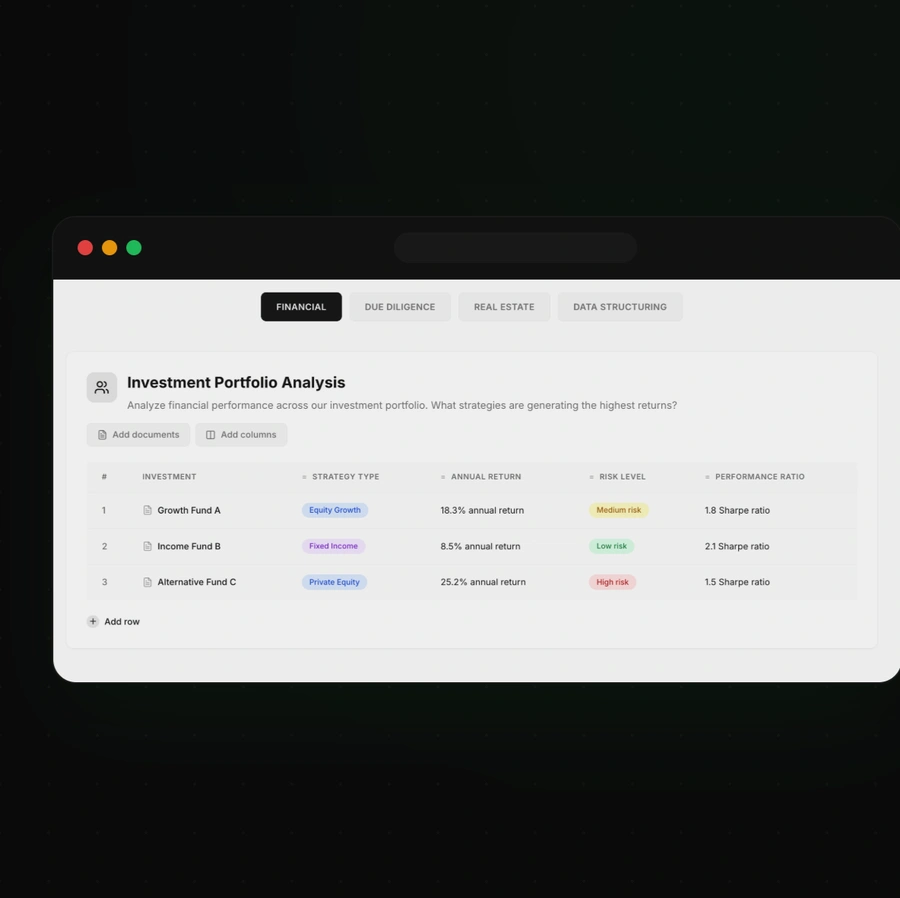
Braind is an AI-powered financial due-diligence platform that automates the analysis of financial statements and contracts, layering in risk scoring and anomaly detection. It compresses the deal-review cycle from weeks to hours while keeping analysts firmly in control of the final judgment. Built for M&A teams and investors, it turns document overload into structured, defensible insight.
Industry · Fintech / M&A
The problem we set out to solve
M&A due diligence is a race against a closing clock, yet it depends on the painstaking manual review of thousands of pages of financial statements, contracts and disclosures. Analysts spend the bulk of a deal window reading, cross-referencing and hunting for the anomalies, hidden liabilities and contractual landmines that can sink a transaction — work that is slow, expensive and easy to fatigue through. Because coverage is bounded by human hours, teams are often forced to sample rather than review exhaustively, leaving risk on the table. The stakes are high: a missed clause or an overlooked accounting irregularity can turn a good deal into a costly mistake, and the pressure to move fast only sharpens the trade-off between speed and thoroughness.
How we built it
Ingest and structure the data room
We built a pipeline to ingest financial statements and contracts, then structure them into a searchable, machine-readable corpus. This gives the AI a clean foundation of the entire data room rather than isolated documents.
Ground analysis with RAG over financial documents
We used a retrieval-augmented generation architecture with LangChain and GPT-4 so that every finding is grounded in the actual source documents. Answers cite the underlying financials and contract language instead of relying on the model's memory.
Layer in risk scoring and anomaly detection
We implemented risk-scoring and anomaly-detection logic to flag irregular figures, inconsistent disclosures and high-risk clauses automatically. Analysts get a prioritized queue of what to examine first instead of a flat pile of documents.
Keep a human-in-the-loop review layer
We designed the workflow so analysts validate, override and sign off on every AI finding before it informs a decision. Braind accelerates the work without removing professional judgment from the loop.
Instrument continuous evaluations
We stood up evaluation harnesses to measure extraction and classification accuracy against reviewed deals and catch regressions. This kept quality high as the model and prompts evolved across hundreds of transactions.
Key capabilities
Financial statement analysis
Automated parsing and interpretation of financial statements to surface trends, inconsistencies and red flags in minutes.
Contract analysis
AI review of contracts that extracts key terms, obligations and risk-bearing clauses across large document sets.
Risk scoring
A structured risk score for each entity and document so teams can triage exposure and focus effort where it matters.
Anomaly detection
Automated flagging of irregular figures and outliers that signal potential accounting or reporting issues.
Source-grounded findings
Every insight links back to the underlying document via RAG, making results traceable and defensible.
Analyst review workspace
A human-in-the-loop interface where analysts verify, annotate and approve findings before they reach a decision.
Outcomes that moved the needle
Braind has been used to analyze 500+ deals, delivering reviews up to 10× faster than a manual process while sustaining a 95% accuracy rate against analyst-verified benchmarks. By pairing RAG-grounded automation with human-in-the-loop sign-off, it lets M&A teams review data rooms exhaustively rather than by sample — turning due diligence from a bottleneck into a competitive edge without trading away rigor.